

The Jewelry Judaica Blog
Happy Shavuot 2017!
Shavuot, meaning “weeks” in Hebrew, marks the end of the seven-week counting period we begin every year at Passover. It is the time, each year, that we celebrate the giving of the Torah at Mt. Sinai to the Israelites, over 3,000 years ago.
It is said that the Torah was given to the Jews just 50 days after leaving slavery in Egypt. This giving of the Torah marks a symbolic covenant between God and the Jewish People, forever changing how the Jewish People interact with God, each other, and the world. Of course, Shavuot is also one of the three pilgrimage holidays of ancient Israel, marking the grain harvest, in which people would bring their harvest to Jerusalem as an offering to God.
There is a wondrous parallel of celebrations here. In one pivotal day in history, Shavuot, a lowly people, recently freed from slavery in a cascade of miracles and utterly dependent on God’s provisions, received the Torah. Fast forward a few years to after the Israelites entered the Promised Land... On that same day, Shavuot, a now strong and free nation, prospering through their own labor on their own land, made annual harvest offerings to God. In this way, Shavuot marks the real completion of the liberation from Egypt, as slaves became a free and prosperous nation.
Shavuot is a “yom tov,” a day without work, marked by many traditions, including:
- Candle lighting
- Eating dairy foods
- Staying up all night to learn Torah
- Going to synagogue and hearing the Ten Commandments read
- Reading the Book of Ruth
Looking for the Perfect Jewish Jewelry Gift? Here’s Where to Start…
If you’re looking for a truly special gift for someone and don’t know what to get them, it’s often hard to know where to start. Chances are, if you’ve made it to this page, you’re considering giving someone the gift of Jewish jewelry. We think that’s a great idea and you’re definitely in the right place. But now what?
It’s not always easy to gauge the personal tastes of even our closest friends and relatives, so it’s often difficult to know where to begin. If you really don’t know where to begin, we usually suggest a pendant and chain. With pendants, there is no ring size to measure or ear piercings to worry about. Pendants are our most popular selling items and work for just about everyone. Because of this, there is a huge selection of styles, motifs, and sizes – priced from under $50 to over $1,000.
So now that you’d like a pendant, you can browse our various menu categories or search the site using your own search terms. With nearly 1,000 items in our store, we’re confident you’ll find something appropriate for your occasion. Here are some suggestions to help you along in your search:
- For men: Look for bolder, heavier Star of David pendants, chai pendants and mezuzah pendants. Ten commandment pendants also work well for men. Try searching “men” in the search bar.
- For women: Most of our designs work well for women. Popular are Star of David pendants, hamsa pendants, and mezuzah pendants. Filigree designs and genstone designs are often more feminine.
- For youth: For bar and bat mitzvahs, try the search terms “bar mitzvah” and “bat mitzvah.” For very young children, try the search term “baby.”
- Don’t forget a matching chain: Chain length is largely a factor of a person's size. A proper fitting chain for a 12-year-old girl will probably be around 16" while it might be 18" for a 13-year-old boy. Adult women will probably wear a chain between 16"-20.” For adult men, this range could be 18"-24."
In some cases, you might want to let someone choose their own piece of jewelry (who knows what these 13-year-old boys like these days?). In that case, we offer gift cards. Problem solved.
If you have any questions or want additional suggestions or advice, please do not hesitate to reach out to us.
Five More Jewish Symbols You Probably Heard About
There are so many symbols and religious objects in Judaism, it can be hard to keep track. Here are another five you might know something about...
1. Lion of Judah
Each of the twelve tribes of ancient Israel had their own unique symbol. The lion was the symbol of Judah, whose territory included the capital, Jerusalem. From the tribe of Judah came the lineage of King David. After most of the tribes of Israel were lost to the Assyrian conquest, those remaining, mostly comprised of the Kingdom of Judah, began to be known as Jews. Over the millennia, the symbol of the lion, often appearing in pairs, has been used as a design motif on Jewish art and ritual artifacts, including Hanukkah menorahs and Torah cases. It endures today as a Jewish symbol of protection and has more recently been adopted by other cultures, including Rastafarians. The Lion of Judah adorns the crest and flag of the Jerusalem Municipality.

Sterling Silver Lion Ten Commandments Ring
2. Shofar
The shofar is a ritual musical instrument made from a ram’s horn. It is used leading up to and during the Jewish High Holidays during prayer. The shofar, mentioned in the Bible, was used to signal holidays, festivals and even war. Today, the shofar is most commonly associated with Rosh Hashanah, the Jewish new year. Jewish men are obligated to hear the sound of the shofar, live and in person, i.e., a reproduction or recording would not fulfill the religious obligation. The shofar is not blown on Shabbat.

Sterling Silver Shofar Pendant
3. Tree of Life
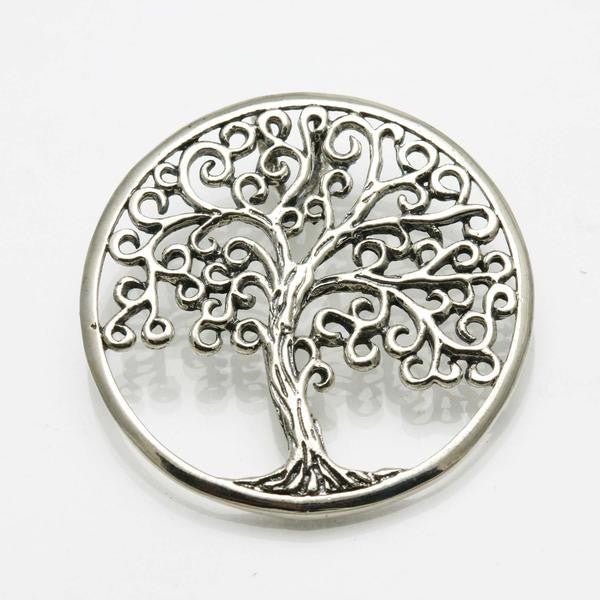
The concept of a tree of life is one shared by numerous cultures around the world. In Hebrew, it is called Etz Chaim. The tree of life is mentioned in a couple places in the Torah, both in Genesis, in reference to the Garden of Eden, and The Book of Proverbs, which associates it with wisdom and serenity. The symbol of the tree of life is also an allegory for the Torah and the study of Torah.

Sterling Silver Tree of Life Pendant
4. Seder Plate
The Passover seder plate is a symbolic display of foods significant to the retelling of the Passover story at the annual seder meal. This retelling focuses on the Biblical exodus of the Israelites from bondage in ancient Egypt. Some foods used on the seder plate are eaten while others are not. The foods consist of:
Maror and chazeret, bitter herbs such as horseradish or romaine lettuce, symbolizing the bitterness of the Israelite lives under slavery. This is eaten during the seder.
Charoset, a paste typically made from fruits, nuts and wine, charoset symbolizes the brick and mortar made by the Israelite slaves. This is eaten with bitter herbs.
Karpas, a vegetable such as parsley or potatoes, are dipped in salt water and eaten, symbolizing the tears and pain of the Israelites under slavery.
Beitzah, a boiled egg, symbolizes an animal offering to God made during the times of the Jewish Temple. The egg is eaten at the meal, often with saltwater.
Zro’ah, or pascal lamb, is a piece of roasted meat that represents the lamb sacrifice the Israelites made on the eve of the exodus and annually at the Jewish Holy Temple before Passover.
The most iconic seder food, the matzah, is kept on a different plate, either beside or under the seder plate. Three matzot are stacked and covered.

Yellow Gold Seder Plate Pendant
5. Dreidel
The dreidel (Yiddish) or sevivon (Hebrew) is a four-sided spinning top and game associated with the holiday of Hanukkah. Each side of the dreidel has a Hebrew letter on it, forming the acronym for “nes gadol hayah sham,” “a great miracle happened there.” This refers to the miracle of the Hanukkah story of the Jewish victory against the Syrian-Greeks and thereafter rededication of the Jewish Temple and rekindling of the Menorah. In Israel, the acronym was changed to “nes gadol hayah poh,” “a great miracle happened here.”
Interestingly, the dreidel and itself was created a few hundred years ago from a German adaptation of an English gambling game called teetotum. The rules of dreidel are the same, with each letter representing an outcome of the player’s spin. נ – collect nothing, ג – collect everything, ה – Collect half, and ש/פ – put in. To this day, it is a favorite game for Jewish children to play on Hanukkah, usually gambling with chocolate candies.

Sterling Silver Dreidel Pendant
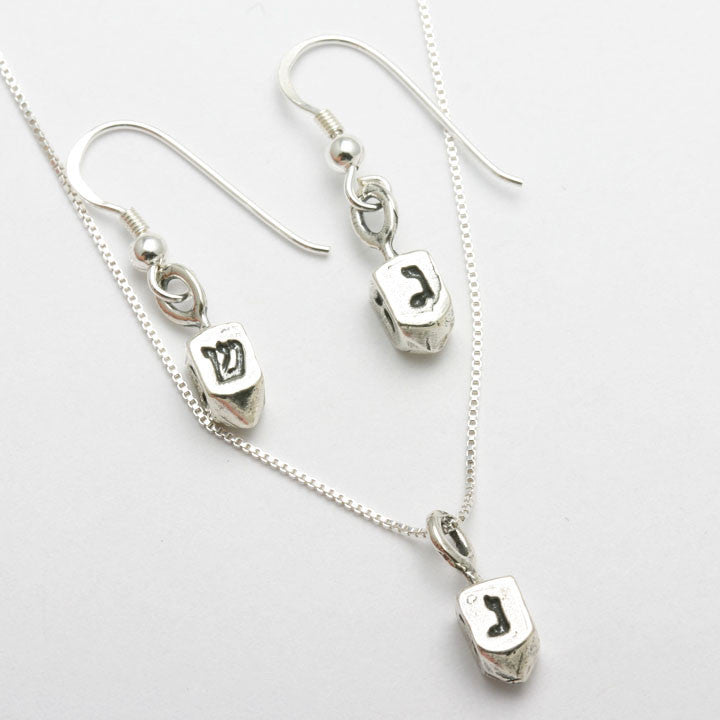
Hannukah Gift Guide
With Black Friday & Cyber Monday around the corner, its the perfect time to start your Hannukah shopping. Right now our entire store is on sale, 25% off! Hanukkah begins on December 24th, 2016, just about 4 weeks from now!
Young girl:


Young boy:


Adult woman:


Adult man:


Hostess gift:


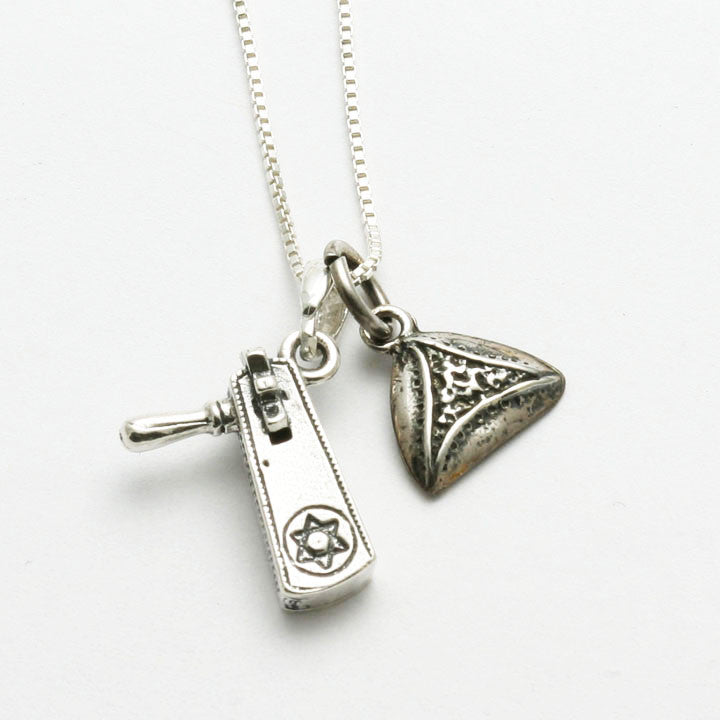
Hamantashen Recipe: Just in time for Purim!
Here is our favorite Hamantashen Recipe (Dairy)
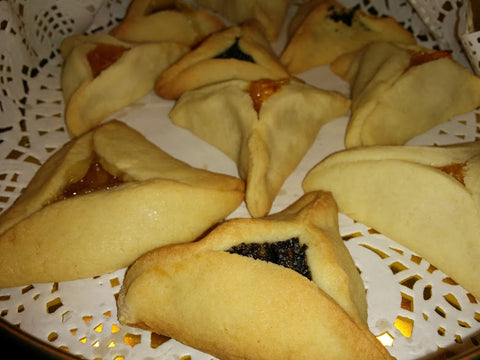
Makes about 24:
1/2 cup unsalted butter
1 cup sugar
2 tbsp milk
1 egg, beaten
1 tsp vanilla extract
pinch of salt
2 cups all purpose flour
Powder sugar for dusting (optional)
For apricot filling:
1 cup dried apricots
1 cinnamon stick
3 tbsp sugar
For poppy seed filling:
1 cup poppy seeds, coarsely ground
1/2 cup milk
1/2 cup golden raisins, coarsely chopped
3-4 tbsp sugar
2 tbsp golden corn syrup
1-2 tsp grated lemon rind
1 tsp vanilla extract
(1) Cream the butter and sugar in a large bowl until pale and fluffy. Mix together the milk, egg, vanilla and salt in another bowl. Sift the flour in a third bowl.
(2) Beat the butter mixture with 1/3 of the flour. Gradually add the remaining flour, alternating with the milk mixture. If the dough is too stiff, add a little extra milk. Cover and chill for 1 hour.
(3) To make the apricot filling, put the apricots, cinnamon and sugar in a pan and add enough water to cover. Simmer for 15 minutes or until the apricots are tender and most of the liquid has evaporated. Remove the cinnamon stick then puree the fruit in a food processor or blender with a little of the cooking liquid to the consistency of thick jam.
(4) To make the poppy seed filling, put all the ingredients, except the vanilla, in a pan and simmer for 5-10 minutes until the mixture has been absorbed. Stir in the vanilla.
(5) Preheat the oven to 350 F. Roll out the dough on a lightly floured surface to 1/8-1/4 inch thick. Stamp out 3" rounds with a plain cutter.
(6) Place 1-2 tbsp of filling in the center of each round, then pinch the pastry together to form three corners, leaving a little of the filling showing in the middle.
(7) Place the pastries on a baking sheet and bake for 15 minutes, or until pale golden. Serve the pastries warm or cold, dusted with icing sugar, if you like.
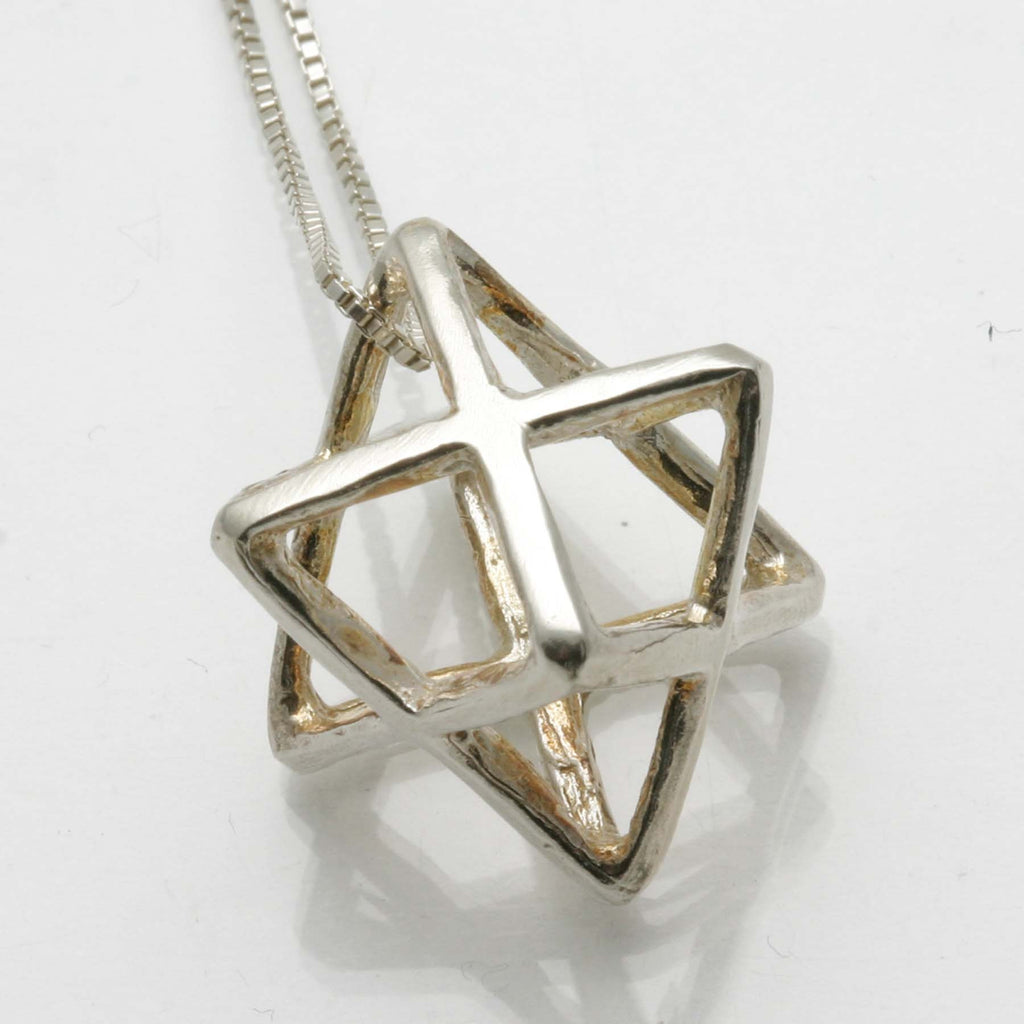
Hanukkah Gift Ideas from Jewelry Judaica
Thanksgiving is almost here which means... it's time to start your holiday shopping! Hanukkah begins on Sunday December 6th, so we at Jewelry Judaica decided to give you an entire week of Black Friday / Cyber Monday savings. We put our entire collection on sale, 25% off! That is the biggest sale of the year!
To help you decide what to buy, here is a handy gift guide of our best sellers for all the loved ones in your life!
Young girl:


Young boy:


Adult woman:


Adult man:


Grandmother:


Did we miss someone? Let us know in the comments below and we will be happy to give you our recommendations.
Happy Thanksgiving! Enjoy your time with your family and friends.
Best,
The Jewelry Judaica Team
Ten Common (and Less Common) Jewish Jewelry Motifs Explained
As one would expect from a nearly 4,000 year-old culture, Judaism is full of religious symbols and iconography. Many of these motifs are commonly used in Jewish art and jewelry. Below we explore some of the most common (and less common) Jewish jewelry motifs. These motifs are sometimes used individually but are often combined with one another in beautiful and original ways…
1. Star of David
The Jewish Star is the most popular symbol associated with Judaism around the world and perhaps the most popular motif for Jewish jewelry. Also called a "Magen David," or "Shield of David," the symbol is said to originate from the shield of the Israelite King David, though its actual origins are not completely clear. In fact, the Jewish Star is a relatively young Jewish symbol and its popular use only dates back a few hundred years. There are many symbolic and Mystical theories about the theological significance of the shape of two intertwined triangles.

2. Mezuzah
Jews are commanded to affix mezuzahs to their door posts to remind them of G-d's presence and commandments in their daily lives. A mezuzah is actually a handwritten parchment paper inscribed with Torah verses. This parchment (klaf) is then rolled up and placed inside the familiar decorative (and protective) case we typically see. Mezuzah cases often prominently feature the Hebrew letter “shin,” or the word “Shaddai,” one of the names of God, and an acronym meaning “Guardian of the doors of Israel.”
The mezuzah has become a strong symbol of divine protection in Judaism. As such, the mezuzah is a popular motif for jewelry, however, one does not find a “kosher,” handwritten klaf in a mezuzah pendant.

Mezuzah pendant with "shin" and Jewish Star
3. Hamsa
The Hamsa, meaning “five” in Arabic, is a hand-shaped symbol that has significance to Jews, Muslims and many Christians. It is a common amulet among North African and Middle Eastern cultures that is said to ward off the evil eye and offer protection. It is a very popular good luck charm and often incorporates other motifs, such as an eye, chai or star.

Hamsa pendant with eye motif
4. Chai
Chai is the Hebrew word for “living,” made up of the letters “chet” and “yod.” The word is a popular symbol in Judaism. Interestingly, the Hebrew numerology of the letters that spell the word correspond to the number 18, making 18 a significant number in Jewish gift-giving. Both the chai motif and the number 18 represent long life and prosperity and the chai has become a popular jewelry motif.
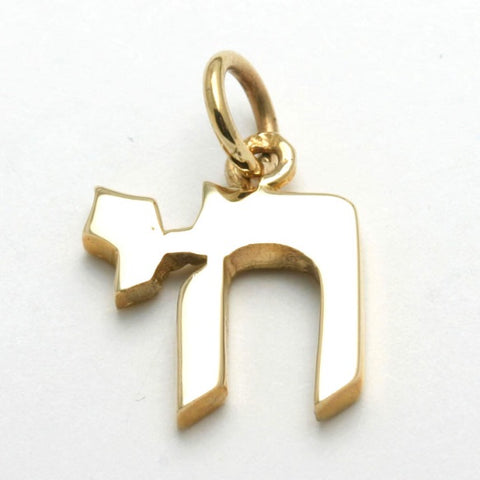
A gold chai pendant
5. Ten Commandments/Torah
According to Jewish Tradition, God gave the Ten Commandments and Torah to Moses and the Israelites at Mt. Sinai soon after their exodus from Egypt. The Torah, the core of the Jewish faith, consists of the written Torah as well as the Oral Law, a tradition passed down for many centuries before being written as the Mishnah.
As such, it is not uncommon to see Jewish Jewelry motifs that depict the Ten Commandments or a Torah scroll as a representation of the theme of Torah, the central aspect of Jewish faith and tradition. Of course, the Ten Commandments is also a popular Christian design motif.

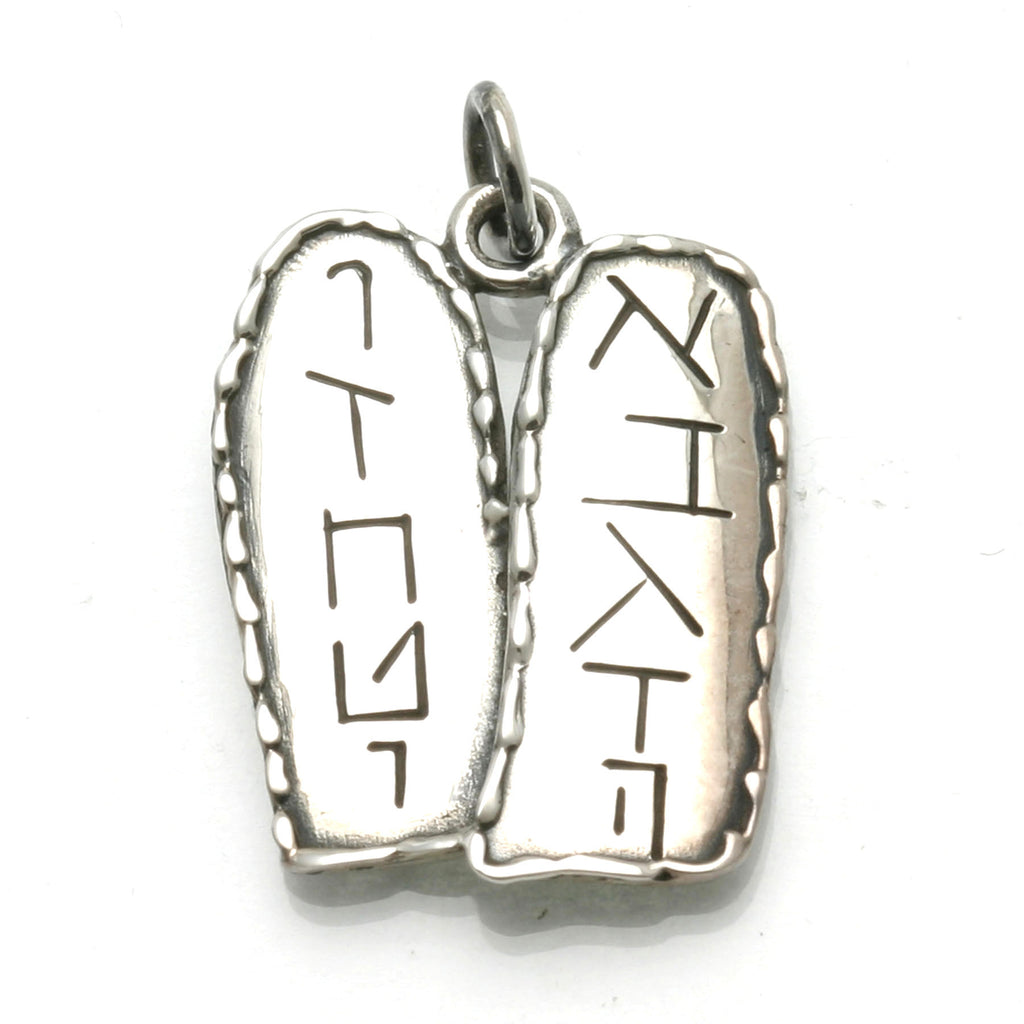
Ten Commandments tablets pendant
6. Shema Yisrael
The word “Shema” is the Hebrew imperative form of the word “hear” and “Yisrael” is the Hebrew for “Israel.” “Hear, Israel…” is the beginning of a section of Torah that is also a central Jewish prayer recited twice daily. The complete first line reads: “Hear, Israel, The Lord is our God, The Lord is one.” The prayer is an affirmation of one God and the acceptance of God’s commandments. The Shema passage is also written in the mezuzah.

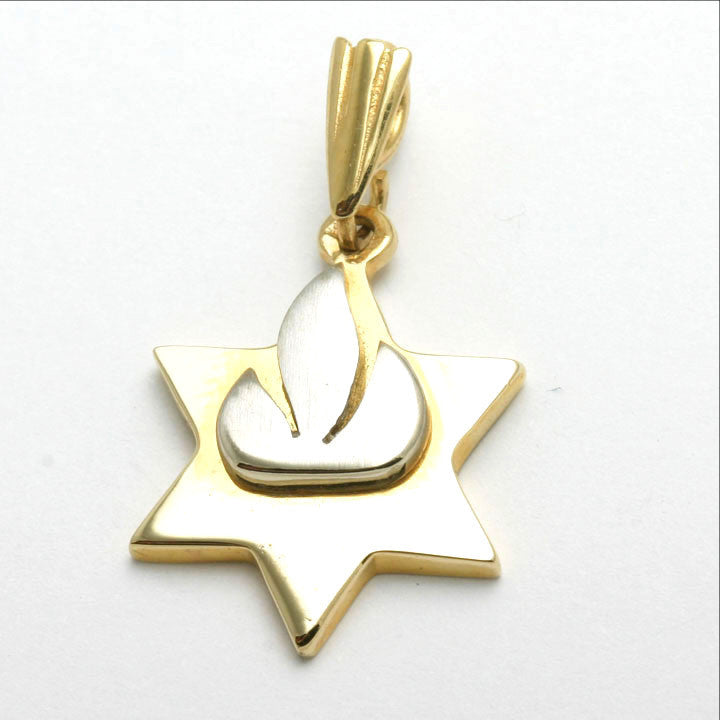
Shema Yisrael pendant in the style of a flame
7. Menorah
The menorah was a seven-branched ritual candelabrum constructed of pure gold by the Israelites after the exodus from Egypt. It was used in the worship of God in the wilderness and later, in the Holy Temple in Jerusalem. Prior to the emergence of the Jewish Star, the menorah was probably the most widely used Jewish symbol.

Menorah pendant
The words “Ani Le’dodi Ve’Dodi Li” come from the Biblical book Song of Songs (or Song of Solomon). The translation is “I am my beloved’s and my beloved is mine.” The book consists of descriptive poetic expressions of passion between lovers, taken traditionally as an allegory of the love between God and Israel.
Today, this passage is very popular for some as an expression of love between a husband and wife and some Jewish women choose to speak these words to their husband on their wedding day. It is also sometimes depicted on pendants and inscribed on wedding bands.

Ring engraved with Hebrew "Ani Le'dodi"
9. Dove
Since the story of Noah and the great flood that nearly destroyed the world, the dove has been a universal symbol of peace and hope. Many people around the world embrace the dove as an expression of optimism for a better future. In Jewish jewelry, the symbol is often combined with other motifs, such as the Star of David or hamsa.

Dove and Star of David pendant
The theme of the Land of Israel, and more specifically Jerusalem (sometimes referred to as Zion), has been a common theme within Jewish culture and art for millennia, especially for diaspora Jews who longed to return to the Promised Land. Sometimes Jerusalem is represented in jewelry form as the Kotel, Wailing Wall or Western Wall, a remnant of the Jewish Temple perimeter wall in Jerusalem and a symbol of redemption.

Western Wall-themed pendant with Star of David

Star of David pendant with the Hebrew word "Zion"
The Menorah is an Enduring Jewish Symbol
Dating back nearly 4,000 years to Abraham, the Jewish People have developed a rich religious and cultural heritage. Like many cultures and faiths, Judaism has many significant objects and traditional symbols. Just a few include the tallit, tefillin, kippah, seder plate, kiddush cup, Shabbat candles, besamim (havdalah spices) lulav and etrog, and of course, the Ten Commandments and Torah. One of the oldest and most enduring symbols of the Jewish culture is the menorah.
The menorah was a seven-branched candelabrum of intricate detail and pure gold construction. It is described in the Bible as God instructs Moses to build it to be used in the Tabernacle, or Mishkan, a portable sanctuary constructed in the desert to worship God after the Israelite exodus from Egypt. The menorah was lit each day using pure olive oil and was operated by the Kohanim, or Jewish priests. It would later be used inside the Temple in Jerusalem.

Above: Depictions of the menorah in the Temple. It is uncertain if the branches of the menorah were straight or curved.
The fate of the original menorah is uncertain. It is believed that the menorah used in the Second Temple was looted when Rome sacked Jerusalem in 70 AD, as depicted by a relief carving on the Arch of Titus in Rome.
Even if its whereabouts were known, like many religiously significant objects described in the Torah, the menorah has no practical use so long as there is no Jewish Temple on the Temple Mount in Jerusalem. However, the menorah endures as an important national symbol of the divine “light” of Torah and of the responsibility of the Jewish People to follow its laws. Today, the menorah is the official symbol of the state of Israel and is featured prominently on the state’s emblem.

Above: Emblem of the State of Israel featuring a menorah
The menorah is also often found as a decorative motif in Jewish artwork and jewelry, though this motif is perhaps less common than some other Jewish symbols, including the ubiquitous Star of David.

Above: A Star of David pendant features a menorah design
The Ner Tamid
The menorah’s enduring symbolism led to the creation of the ner tamid. The ner tamid, or eternal light, is a lamp typically found in Jewish synagogues above the ark that houses the Torah scrolls. Following the destruction of the Second Temple, community synagogues emerged as the primary place of Jewish worship and these lights became symbolic analogs of sorts for the menorah. As its name suggests, the ner tamid is a light that is never turned off, much as the menorah and altar were constantly lit in the Temple in Jerusalem.

Above: A ner tamid in a synagogue
The Hanukkiyah
Another Jewish object that is evocative of the menorah is the hanukkiyah (hanukkiah), or Hanukkah menorah. Though the hanukkiyah is a nine-branched candelabrum, whereas the menorah had seven branches, the typical hannukiyah’s branched appearance is clearly similar to that of the Temple menorah. The connection is purposeful as the hanukkiyah was designed to remind Jews of the well-known Hanukkah miracle involving the menorah.
In 201 BCE, the Seleucid (Syrian-Greek) Empire conquered Judea and made it a client state. In 168 BCE, the army of King Antiochus IV sacked Jerusalem, defiled the Jewish Temple, and imposed a series of laws against Jewish customs and worship. This led to the Maccabean Revolt against Hellenistic rule and influence in Judea. Following the defeat of the Seleucid army and the recapture of Jerusalem, a single day’s worth of oil miraculously burned in the Temple menorah for eight days; long enough for the Jewish priests to make new oil as they purified the Temple’s religious objects and rededicated the Temple to God. The word “Hanukkah” actually means “dedication” and Jews are commanded to remember this event by lighting the Hanukkah menorah during the eight nights of the Hanukkah holiday.

Above: A lit hanukkiyah
Recipe: Amazingly Simple Spicy Sriracha Schnitzel
Everyone loves schnitzel. If you don't, your loss.
Since I got married, I've become somewhat of a schnitzel maven. Eaten with hot mustard, it's one of my absolute favorites. Even my wife, who doesn't love chicken, looks forward to schnitzel night. Recently, I started experimenting with adding flavors to the egg wash, cause why leave a good thing alone... After a bit of trial and error, sriracha sauce is the clear winner. Here's my very simple recipe:

- 1 package (1-1.5 pounds) thin "schnitzel' cut chicken breast
- 2 large eggs
- Bread crumbs (Any will do but I like Osem's Homestyle with Sesame)
- Sriracha sauce
- Peanut Oil (or any frying oil)
Start by trimming the chicken. Of you don't have schnitzel fillets, you'll want to butterfly the breast. Brine the chicken by placing the pieces into a large bowl of well-salted water (about a cup of salt per gallon). You won't need to leave it in long for the chicken to take in the brine since it is cut thin; between 30 and 60 minutes. This step will help keep the chicken moist when frying and you won't need to add salt. When enough time has passed, remove the chicken and dry it thoroughly with paper towel (so the other ingredients will adhere well) and then cut into strips.
Crack 2 eggs and whisk in a smaller bowl. Add approximately 2-4 tbsp sriracha sauce (to heat level desired) and mix well. For my basic recipe, I hold the sriracha.

I generally don't coat the chicken in flour before dipping in the egg mixture but you definitely can if you like. Dip the chicken in the sriracha and egg mixture and then dredge in bread crumbs.
Heat about 1/4 inch of oil in large frying pan and pan fry both sides of chicken until golden brown on both sides.
Let cool on paper towel to absorb excess oil. Enjoy!
BTW this is my favorite mustard with which to enjoy schnitzel: Silver Spring Beer'n Brat horseradish mustard.

A Personal Reflection on Lag B’Omer and Israel
When I was in college, I had the opportunity to live in Israel and study at Tel Aviv University. It was the best time of my life. I had been to Israel so many times before on vacation, but this was my first opportunity to live there and take in all that the amazing country has to offer. Interestingly enough, one of my strongest memories from living in Israel is celebrating Lag B’Omer. Lag B’Omer is not one of the most important holidays. There are no special prayers or special foods, it’s just a time to celebrate.
I was pleasantly surprised to see that in Israel, everyone participates in Lag B’Omer festivities. Every empty lot has a little bonfire in it. You see kids everywhere, whole families huddling around cooking their potatoes in the fire. It’s a true sensory experience. You can see and smell the holiday everywhere you go, and the smell of the smoke and fire lingers for the next few days! It was so exciting to see the joy and excitement in the masses of people standing in the streets together.
That’s the thing about living in Israel. You don’t have to be religious or observant to feel your Jewish identity. Living there, the language is Jewish, the culture is Jewish, the air you breathe is Jewish. Many Israelis probably don’t know or care that this day marks the end of the plague that killed the students of Torah sage Rabbi Akiva or that we light bonfires is to celebrate the life of his disciple, Rabbi Shimon Bar Yochai. On Lag B’Omer in Israel, it’s not about religion for most people. You simply participate, you celebrate, you live life.
As I reflected on this memory, it got me thinking about Israel today. With Lag B’Omer as an exception, many secular Israelis equate observing Jewish holidays with being “religious.” And in Israel, being religious is a stigma and the source of many political fights. As a Jew (traditional but not religious) living in the diaspora, it saddens me (although I do understand where it comes from) to see how much hatred and negativity are placed on religious Judaism by Jews who consider themselves “Jewish enough” just because they live in Israel.
Obviously, this feeling is unique to Israel. When many of these same anti-religious Israelis leave Israel to live in the diaspora, they realize that Judaism was a bigger part of the fabric of their being than they ever realized. They begin to seek out Judaism because they miss it. They long for it. And they finally see that for most of the world’s Jews and throughout most of the history of the Jewish people, Jews have had to work at maintaining a Jewish identity. Now, these former ridiculers of Judaism are planning large Rosh Hashanah dinners and Passover seders. And they still head down to the beach for a bonfire on Lag B’Omer. Only now, they realize how lucky they were to have lived in such an amazing country where they got to live, eat, and breathe Judaism without even trying.
Baking for Purim with the family is so satisfying!
Purim has always been one of my favorite Jewish holidays. Not only do I love the story and the message of Purim – you can keep trying to kill us, but we Jews are here to stay, but I love all the customs that go with it. As a kid, attending our school Purim carnival was the highlight of my year. The costumes, the excuse to have fun, rejoice and be proud to be a Jew. Now that I’m older and I’ve basically outgrown the dressing up and Purim carnivals, I look forward to the parties, drinking and of course, my favorite, hamantaschen.
For the past few years I’ve been making my own hamantaschen from scratch, including the fillings. And I’ve made it a family event, teaching my niece and nephews the recipe and techniques and making it a fun activity for everyone. And it has paid off. When they hear Purim is coming up; their first question is, when can we make hamantaschen? For me that is a small victory in the preservation of our culture. I’m happy that they have a strong association with this holiday, even if it seems like it’s just about dessert, it’s really so much more.
I’ve been really happy with the cookie dough-like recipe that I found. It was the first recipe I ever tried and it’s been a winner. This year, with the explosion of Purim on social media (especially Pinterest and Facebook), I started thinking about Hamantaschen earlier than usual. Everywhere I looked were the most amazing DIY mishloach manot baskets and creative sweet and savory hamentaschen recipes. As much as I would love to try them all, I work full time and just don’t have the time. Then I saw the article “Thanks but no thanks, Purim Pinterest” on Kveller, and even though I love baking and crafting, it definitely resonated with me.
So while I fully recognize that I’m only human and can’t do EVERYTHING I want to do, I decided to just try to add two new fillings to hamantaschen repertoire. The recipe that called out to me the most was for Tagalong hamantashen (probably because Girl Scout Cookie season just ended). So when I made my first batch of hamantashen last night, I set aside some dough and filled it with a peanut butter mixture and dipped the bottom in melted chocolate. And the result… DELICIOUS!
I generally make apricot and poppy seed filling. This year I also added a spiced pear filling (I have a thing for pears and it was delicious). So I ended up with 4 delicious hamentashen flavors.
"Tagalong" hamantaschen recipe:
http://www.myjewishlearning.com/blog/food/2015/02/17/tagalong-hamantaschen/
Disclaimer: The recipe I linked to calls for a shortbread style cookie dough. I just used my regular cookie dough and it came out perfect.
PB&J challah is delicious. You should try some. But not this one. This one is mine. Make your own.

If you've had it, you know how darn good fresh challah is. It's warm, yeasty, spongy, a little chewy, a little eggy, a little awesome. It happens to be one of the most delicious parts of the Sabbath meal, or any meal for that matter. It's not only a traditional part of Jewish culture, but it's also an important mitzvah for women.
At JewelryJudaica.com, we sometimes keep things traditional, but then again, sometimes we don't. Recently, we were inspired to take our traditional family challah to the next level. Not that regular challah needs any improvement, really, but making flavored challahs can be a nice change. This time it was peanut butter and jelly challah. Sure, its been done before, but not by us! This was also my first time making challah so I was learning the basics along the way from my wife.
We typically make a four braided challah with a recipe as follows (makes two loaves):
- 2 1/2 cups warm water
- 1 tbsp yeast
- 1/2 cup honey OR 3/4 cup sugar
- 1/4 cup oil
- 4 eggs
- 1 tbsp salt
- 8 cups flour
- 1 egg, beaten for brushing
Directions:
Sprinkle the yeast into warm water and let it activate for 1-2 minutes. Mix in the eggs, oil, salt, and honey (or sugar). Add the flour, one cup at a time. Knead for 10 minutes.
Set aside in a well-oiled bowl and cover with a moist towel. Let rise for 2 hours, or until double in size.
Shape the challah* (using extra flour as necessary) and brush on beaten egg.
Set in pan and let it rise for another hour.
Bake for 30-40 minutes in a preheated oven at 375 degrees F.
*For the PB&J variation, we separated the challah into 4 pieces when getting ready to braid. Normally, we'd roll these into roughly 15" strips and then braid. But this time, we flattened out the strips, smothering two each with peanut butter and raspberry preserves (we used preserves because of the solid consistency) and then rolling them up. Strawberry or grape would be good too, I think.

Then braid as usual.


My wife taught me to braid but my braiding technique clearly needed work. I've since improved, I promise.

A bit of leakage here. Did we overfill the challah with preserves or just not seal it well enough?

Looks aside, this challah turned out to be quite delicious! It was especially good fresh. Basically, it tasted like a freshly baked PB&J challah sandwich.

It was also amazing as french toast. Dessert breakfast, anyone?
Let us know if you try this recipe. We'd love to hear your thoughts!